Wednesday, September 30, 2009

Latest Additions to The Dog Jewelry Museum

Two "new" manufacturers just added to the Dog Jewelry Museum. First off, Wild Bryde Jewelry necklace of a multitude of dog breeds. Wild Bryde specializes in animal and nature jewelry. Started in 1980 in a garage by Mike Warner and Tracy Holzman, much of their jewelry has a silhouette look, done in light weight metals. The necklace is great fun, featuring breeds from a long-coated Chihuahua to a St. Bernard.


Here's a close up of a couple of the dogs:


Next, the Lang company was in operation from the mid-1940s to about the mid-1970s. Just added to the Museum, is this sweet Spaniel puppy in sterling silver. This piece can be found now and then on websites or Ebay. I expect it is from the 1950s, a time when Cocker Spaniels were especially popular in the US.


Finally, another addition to our growing collection of "real breed" jewelry from Trifari. Here's a gold tone smooth-coated Chihuahua, delightfully detailed. Just when I think I've got all of the dogs in this series, I spot another breed! Check out the other Real Dog Breed pieces in the Trifari section at the Museum.

Thursday, August 27, 2009

The Whys and Wherfores of Collecting

Some of you have asked why The Dog Jewelry Museum exhibits low-end pieces as well as better, more valuable items. Here's a few reasons:

First, some of the less expensive pieces are quite remarkable. The range of dogs from a manufacturer like J.J. (Jonette Jewelry) is impressive. For those interested in collecting a wide variety of breeds or humorous canine jewelry, J.J., though inexpensive, is a good choice.


J.J. Basset Hound Pin with Moving Ears

Second, both collectors and dealers may not realize how common or uncommon, a piece may be. Enamel scatter pins come in a huge range of breeds, colors, and manufacturers. There is some value in knowing that a good example of a Har enamel dog is quite a bit rarer (and worth more than) one made by Gerry's.


Rare and Valuable HAR signed enamel above, more common, less valued signed Gerry's below.


Third, we all start somewhere. The nice thing about collecting costume jewelry is that you can get your feet wet without drowning. For a few dollars you can start a collection and learn about condition, values, scarcity, and what you really like. A collection can always be upgraded.

Finally, collectors are often "completists" ... wanting to get a representative sample of every variation. High or low end doesn't matter, it's getting the whole range that counts.

Bottom line...when startng a dog jewelry collection, collect what you like and what you can afford!

Saturday, August 22, 2009

All better now!

Thanks to the help of an excellent support staff at my web host, I've recovered all the data and got The Dog Jewelry Museum back up and running! If you come across any issues, please let me know.

Good news! The Kennedy Museum of Art in Athens, Ohio is planning the following:

Collections Collected: The University Collects and Athens Collects Miniatures A Project by Mark Dion with Kennedy Museum of Art
September 24 – November 29, 2009
Opening Reception: Thursday, September 24, 6 – 9 PM

We've been invited to loan over 50 pieces to the exhibit! So the dog jewelry will be in a physical Museum in late September. Athens and the SE Ohio region is a beautiful place, especially in the fall, so if you are looking for a mini-vacation, you might consider coming out this way. See the exhibit, the leaves, and enjoy some Appalachian hospitality!

Here's a page with the pieces we've selected to go to the Kennedy Museum http://www.kelpies.us/djm/kennedy_list.htm. The curator asked for pieces that covered a range of periods (ours are from about 1900 to the present) and a wide selection of dog breeds. The Kennedy folk were really excited when we brought the bin by with our selections.

I do plan on getting back to the topic of bulldogs. Just added a WONDERFUL piece, circa 1924 carved wooden bulldog representing
Sargent Jiggs
the US Marine Corp. mascot who joined the core in 1922. Read more about this piece at the listing here.

Also just added a fantastic Mid-Century Modern copper Scottie dog by Renoir, a Trifari real look Miniature Schnauzer (the very first piece of dog jewelry I ever owned), and coming this week is an enamel cartoon dog from the show Two Stupid Dogs (an incredibly silly cartoon, that makes me laugh just thinking about it!)

As always, just go to The Dog Jewelry Museum and click on Enter the Museum.

Tuesday, July 28, 2009

HACKED!

Over the July 4th weekend some people with way too much time on their hands hacked websites all over the world. One of those hacked, was the server that hosts The Dog Jewelry Museum.

After much angst, the great support staff at Webmasters managed to recover my database of images and restore the software that runs it. We are still ironing out some glitches, but the Museum is back up and running.

Four new dogs were added today. A beautiful Bogoff rhinestone Wire-haired Fox Terrier, a rare Sandor signed Christmas poodle pin, an Accessocraft hunt club style pin, and a 1940s potmetal sighthound. Check out the new additions and the other 640 pieces at The Dog Jewelry Museum (click on Enter the Museum).

Saturday, March 28, 2009

Breed Jewelry: Bulldogs and Their Cousins Part I

Bulldogs are a humorous and fascinating category of collecting. There is a great range of costume jewelry featuring the pugnacious canine, as designers find the "so ugly it's cute" face irresistible.


The English Bulldog harks back to butcher's dogs, used to control cattle. They were then adopted to the "sport" of bull and bear baiting, and the dog was bred for ferociousness and physical traits which would allow it to catch the bull by the nose, hang on, and survive the experience. In 1835, the practice was banned in England, and those that loved the breed began breeding for a more sedate temperament. (For more history of the bulldog breed, check out this website.) The modern bulldog is a sedate animal, with the characteristic pushed up face and wrinkles.

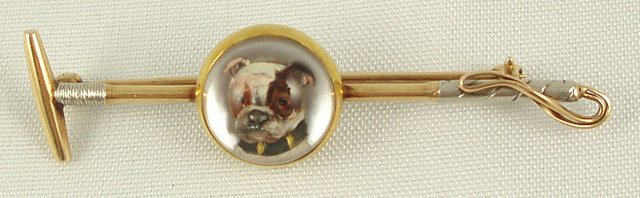
Bulldogs have been found in fine jewelry for centuries. Particularly intriguing are the reverse carved Essex glass pieces and hand painted enamel pins.


Essex Crystal from the Cathy Gordon collection.


Costume jewelry bulldogs come in a variety of materials and designs. Wood and plastic are favorite materials.


Wood & Leather Bulldog from the DJM


Black vintage plastic comic bulldog pin set from the DJM


Designers & Bulldogs

Perhaps the most famous costume jewelry bulldogs are from Joseff of Hollywood (1938-present, see Researching Costume Jewelry for more information.).


Joseff of Hollywood stamped bulldog front and back from the DJM.

Coro's Mrs. Dog is a bulldog. This is part of a set (Mr. Dog has a top hat.)


Coro Mrs. Dog from the DJM.


To be continued...

Monday, February 23, 2009

Prices, Values, and Dog Jewelry

Pricing or valuing jewelry is probably one of the most difficult areas for the dealer or collector. Unlike fine jewelry (which, if nothing else, can be melted down for its gold content), costume jewelry has no intrinsic value. So determining what a piece is worth can be quite the trick.

When assigning a value to pieces in The Dog Jewelry Museum (DJM), there are a number of approaches that are used. First is finding comparable prices. Just like with real estate, it helps to be able to look at what others are charging for the same or similar items. Keep in mind that to be truly comparable, the pieces need to be exact matches and in the same condition.

Sites reviewed include Ebay, Ruby Lane, E-crater, and individual online websites (see The Dog Jewelry Museum Friends for a list of good sites to visit). Keep in mind that most of the time, prices on Ebay will be lower than most of the other venues. Ruby Lane, other online malls and websites will offer pieces at retail price. The range from an Ebay wholesale price (of course sometimes a bidding war on Ebay will drive prices much higher than you might see elsewhere) to a high end retail price gives a general idea of the current value of the piece.

Another way value is determined is by what price is paid for the item. The Dog Jewelry Museum attains pieces by buying online from wholesale, retail, and auction sites and offline from rummage, estate, and private sales. Pieces are also donated to the Museum from artisans, collectors, and dealers. When a donated piece is received, the value supplied by the donor (when available) is used in the listing. When a piece is purchased, that price is used along with comparables to establish a range of value. Often in DJM listings, a range will be listed. The bottom of the range is the lowest price found and the top is the highest found. Again, this is taking into account that the piece is an exact match to that valued and that conditions are similar.

Condition does present an issue in valuation. If a piece is not in excellent condition, the value goes down. Generally speaking, a piece in very good condition will be valued 10-25% less than one in excellent condition. A piece in good condition will be valued 50-75% less than one in excellent condition, and a piece in fair or poor condition will have a minimal value assigned. The only exception to this is if the piece is exceedingly rare and highly collectible.

What exactly is "exceedingly rare" and "highly collectible"? Exceedingly rare pieces are those that may not appear on the market in a decade or more. They may only be known by collectors from one example in a good reference book or perhaps from a premiere collection shared online. Or perhaps a design patent is available that confirms details on a piece that may never have been seen in the marketplace.

Even if a piece is truly rare, it may not be highly collectible. Excellent design, fine craftsmanship, well known makers, and whimsical representation as well as condition all contribute to making a piece highly collectible. If a piece is both rare and collectible, then it will be more highly valued, even in a lesser condition, than common pieces in excellent condition.

Values for dog jewelry are not fixed. Markets change based on the economy, fashion, number of collectors, availability of pieces, and other factors. Recently, there have been more pieces previously thought to be rare coming on the market as collectors sell out or pass away. These infusions of "new" pieces are part of what makes valuing costume jewelry more an art than a science. The Dog Jewelry Museum curator views literally hundreds of pieces of dog jewelry each day and this provides a good picture of what the current market looks like. Values in DJM listings can and are changed to reflect the market as time allows.

What about book values? While they make interesting reading and it is fun to find a piece in the book, for the most part these values are unconnected to current market conditions. There is too much lag time from when the book is compiled to when it is published, to make values realistic. A good reference book is always helpful to a collector or dealer, but the price guides are academic information, at best.

Comparable prices, prices paid, rarity/collectibility, conditon, and market forces are the keys to valuing canine costume jewelry.

Tuesday, January 27, 2009

Artisan Profile: Haleyanne Dog Jewelry

The fun thing about dog jewelry is that it comes in so many different materials, styles, and breeds! I recently stumbled across a wonderful artisan pair, Haley Land and Leanne Clarke who sell their whimsical canine creations at Seattle's Pike Place Market and online at their website Haleyanne Jewelry. Haleyanne started selling handmade goods in 1985 and have specialized in dog jewelry since 1994.

Haleyanne jewelry is molded ceramic pieces given dimension and expression through creative eyes and hand-painted glazes. The Haleyanne "look" is distinctive, with each breed having wonderful and humorous expressions. Variations and customization is achieved with painting and glazing. While not all breeds are available, well over 50 in a variety of colors, are to be found at their website.

Leanne Clarke donated two fantastic pieces to The Dog Jewelry Museum, an adorable Pembroke Welsh Corgi in caramel and white and a liver and white German Shorthaired Pointer.

Haleyanne Pembroke Welsh Corgi

Haleyanne German Shorthaired Pointer

Haleyanne jewelry is well made, sturdy ceramic with a security clasp pin back which is glued in place. Some pieces are signed, but the signature may be obscured by the glue and pin back. Still the distinctive look of these nifty pieces are readily identified. The pieces are about 2 inches in size -- large enough to be readily noticed on a lapel or hat!

Haleyanne will customize existing molds to represent other breeds and may be able to customize color glazes as well to personalize your creation. Contact these artisans via their website.

Ceramic dog jewelry is available from the Haleyanne Jewelry website.